
DMDO: Distributed Multidisciplinary Design Optimization#
Design the whole system, let every discipline keep its own tools. DMDO decomposes a coupled multidisciplinary design problem into subproblems, solves each one with the optimizer that suits it, and coordinates them until the disciplines agree on one consistent, optimal design.
Why DMDO#
Aircraft, vehicles, turbines and energy systems are designed by teams that each own an analysis: aerodynamics, structures, propulsion, controls, cost. Optimizing them as one monolithic problem requires a multidisciplinary analysis (MDA) that converges at every design point, a single optimizer that suits every discipline, and every code in one process. DMDO removes those three requirements.
No converged MDA needed. DMDO implements nonhierarchical analytical target cascading (NHATC) [Tosserams et al., 2010]: each subproblem keeps local copies of the variables it shares with others, and an augmented Lagrangian coordinator drives the copies to agreement. Coupled analyses never have to be iterated to convergence inside the optimizer.
The right optimizer for each discipline. A subproblem built on a noisy simulation can use derivative-free Mesh Adaptive Direct Search (OMADS [Bayoumy, 2022, Audet and Dennis, 2006]), while a smooth analytical one uses SciPy’s SLSQP, in the same run. Any other optimizer plugs in through a five-line strategy class.
Measured on the classic MDO benchmarks. On the Sellar problem [Sellar et al., 1996] with MADS subproblems, DMDO reaches \(f = 3.2042\), 0.65 % from the best known solution \(f^\ast = 3.18339\) [Tedford and Martins, 2010], with the disciplines consistent to \(1.3\times10^{-6}\). Across the six recorded regression runs (Sellar, Golinski’s speed reducer, a geometric program and a basic two-discipline problem), the maximum inconsistency between disciplines falls below \(10^{-3}\) within 6 to 16 outer iterations; see Benchmarking.
Serial, parallel or distributed, with the same answer. Subproblems can be swept one after the other (Gauss–Seidel) or all at once (Jacobi) in-process, in a pool of worker processes, or on remote machines. Jacobi results are merged in subproblem order, so they do not depend on which worker finishes first.
An API, not just a script. Build a problem from YAML, a dictionary or Python objects, then drive it with
run(), one outer iteration at a time withstep(), or solve the subproblems yourself withask()/tell(). Observers stream progress, registries and entry points add solvers, executors and analyses, and an optional HTTP service exposes sessions to any language.Results you can reproduce. Runs are seeded, every regression problem is checked against a recorded history that the current code must reproduce bit for bit, runs can be checkpointed and resumed exactly, and the test suite runs on Linux, Windows and macOS.
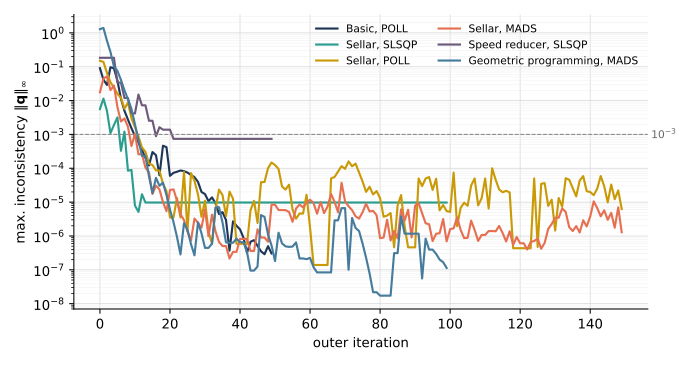
Figure 1 Maximum inconsistency between disciplines at each outer iteration of the six recorded regression runs.#
Main features#
Nonhierarchical target cascading with an augmented Lagrangian penalty and method-of-multipliers updates; penalty weights grow only on couplings that stall.
mads, poll and search from OMADS, scipy (SLSQP, COBYLA, …), or your own
BaseSolver registered by name or entry point.
Sequential sweeps that use the latest targets, or parallel sweeps whose results are independent of the execution order.
run, step, ask/tell, early stopping, JSON-ready results, checkpoints and exact resume.
Hooks on every phase of the coordination loop; registries for solvers, executors, analyses and coordination policies.
dmdo serve and dmdo worker: drive sessions over HTTP and pin subproblems to the machines that hold
their analysis codes. Standard library only.
Minimal example#
The problem is described in a YAML file (variables, analyses, subproblems, coordinator); the analyses and objectives are ordinary Python callables, given by name.
import numpy as np
from DMDO import Session

def A1(x):                       # analysis of discipline 1: a = log10(u) + log10(v) + log10(b)
    x = np.maximum(x, 1e-12)
    return [np.log10(x[0]) + np.log10(x[1]) + np.log10(x[2])]

def A2(x):                       # analysis of discipline 2: b = 1/u + 1/w + 1/a
    x = np.maximum(x, 1e-12)
    return [1 / x[0] + 1 / x[1] + 1 / x[2]]

def opt1(x, y, c=None):          # subproblem 1: objective u + v + b + a, no constraint
    return [sum(x) + y[0], [0.0]]

def opt2(x, y, c=None):          # subproblem 2: no objective, constraint w + b - 10 <= 0
    return [0.0, [x[1] + y[0] - 10.0]]

if __name__ == "__main__":
    session = Session.from_yaml("basic_problem.yaml", working_dir="runs",
                                blackboxes={"A1": A1, "A2": A2, "opt1": opt1, "opt2": opt2})
    result = session.run()
    print(result.status, result.iterations, result.objective, result.max_inconsistency)
    print(result.variables)      # final copies of every variable, e.g. {"u_1": ..., "u_2": ...}
Getting started walks through this problem and its YAML file line by line.
Organization of this documentation#
- Getting started
Installation, a first run, the structure of a problem definition and the contract of analyses and objectives.
- Background
Decomposition-based MDO, analytical target cascading, the NHATC formulation and the augmented Lagrangian coordinator, with the algorithms given as pseudocode.
- Implementation
How DMDO is built: the package layers, its interfaces, the coordination loop, executors, observers, sessions and the service layer.
- Benchmarking
The regression problems and the recorded results on Sellar, the speed reducer and the geometric program.
- Tutorials
Worked examples: the basic problem, Sellar with three inner solvers, parallel and remote execution, the Session API, extension points, the HTTP service and the post-processing dashboard.
- Problem definition and Outputs
Complete description of the problem-definition keys and of the files a run produces.
- API reference
Reference of the public classes and functions.
Citation#
If DMDO contributes to published work, please cite it as follows.
@software{DMDO_AB,
  author    = {Bayoumy, Ahmed H.},
  title     = {DMDO: Distributed Multidisciplinary Design Optimization},
  year      = {2022},
  publisher = {GitHub},
  version   = {2612.0},
  url       = {https://github.com/Ahmed-Bayoumy/DMDO}
}
License#
© Ahmed H. Bayoumy 2022–2026. DMDO is free software distributed under the GNU General Public License, version 3 or later; see the LICENSE file.